
Criminal Court Records in Leflore County
A criminal court record is the case file a clerk opens the moment the State brings a charge. It is more than an arrest sheet. The file gathers every paper the case produces, from the charging document through the judge's final order. In Leflore County the Circuit Clerk maintains criminal files for the Circuit and County courts, and the Justice Court Clerk and the Greenwood Municipal Court keep their own records for the cases they hear.
Which court holds the file depends on the offense. The Circuit Court is the county's felony venue, and it sits in the Fourth Circuit Court District with Sunflower and Washington counties. The Justice Court handles misdemeanor charges and the preliminary stage of a felony before it moves up. Greenwood Municipal Court takes city misdemeanors, ordinance violations, and most DUI cases written inside the city. Each level builds its own record, so a single person can appear in more than one court file.
The Circuit Court bench covers more than Leflore alone, and the judges rotate through several counties. Sitting judges include Carol White-Richard, Richard A. Smith, Margaret Carey-McCray, and W. Ashley Hines, and their conference leadership work is noted on the Mississippi Judiciary circuit and county court news page.
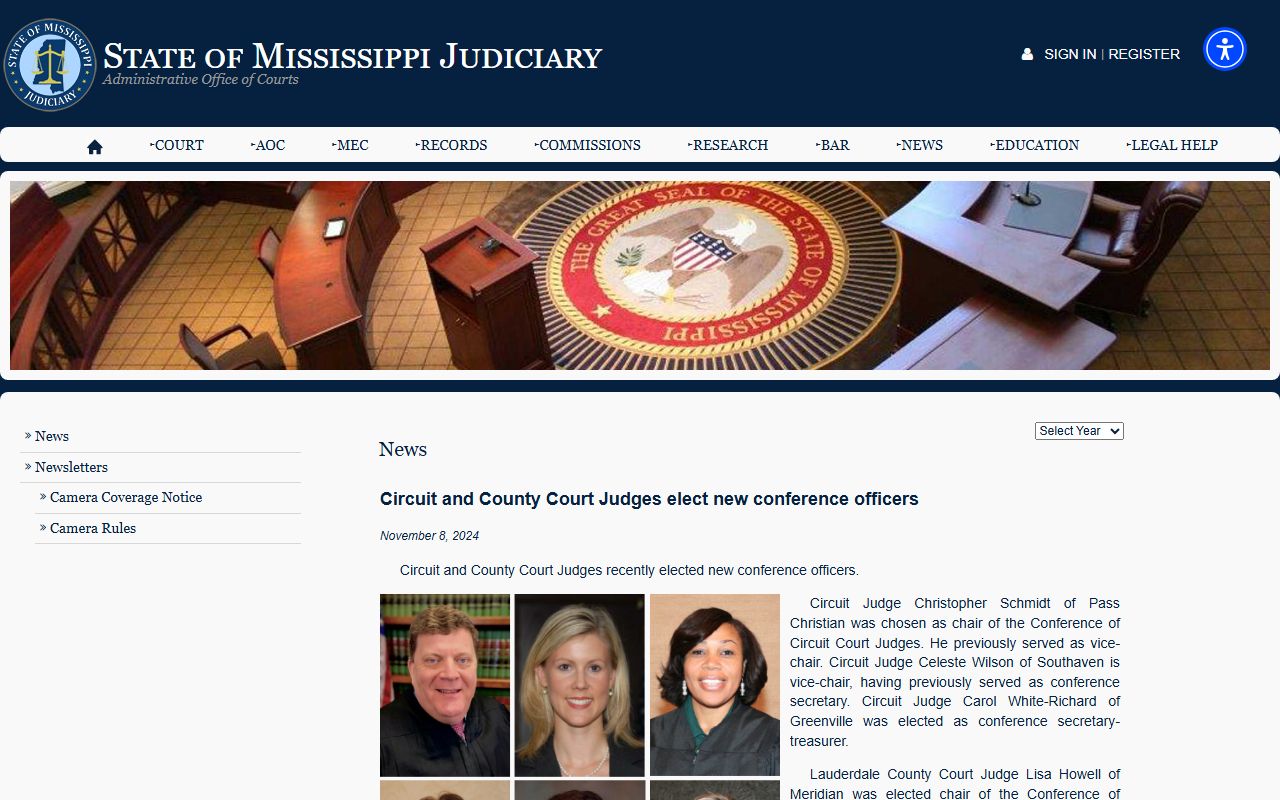
That same news item shows how a felony judge's calendar spans the whole district, which is why a Leflore felony file may carry hearing dates set in a neighboring county courthouse.
How to Search Leflore County Criminal Court Records
Leflore County does not run a single free portal that returns every criminal case at once. The statewide system is Mississippi Electronic Courts, known as MEC or PAMEC, which holds circuit, county, and chancery filings. The public sign in page is login gated, so it shows account fields rather than an open search. When MEC is not available, the file is reached by calling or visiting the clerk that holds it.
Before you start, gather the defendant's full legal name, any aliases, a case number if you have one, the rough filing or arrest date, and the court that heard the matter. A narrow request is what lets a clerk pull a file quickly.
- Identify the court. Felony files point to the Circuit Court and the Circuit Clerk. Misdemeanor and preliminary felony matters point to the Justice Court. Greenwood city charges point to the Municipal Court.
- Search MEC at the state sign in page if you hold an account and the case is electronic.
- If there is no login or no match, call the correct clerk. The Circuit Clerk is (662) 453-1435, the Justice Court is (662) 453-1605, and the Greenwood Municipal Court is (662) 453-3311.
- Give the clerk the name, case number, approximate date, and the document you want, such as a docket sheet, judgment, or sentencing order.
- Ask which copy type is available and confirm the current fee and delivery method before you pay.
For sentenced defendants, the Mississippi Department of Corrections runs a statewide inmate search that returns custody and status detail the county clerk does not. That tool is keyed to name or MDOC number and is separate from the court case file itself.
Stages of a Leflore County Criminal Case
A criminal case moves through fixed steps, and each one leaves a mark in the record. Reading those entries in order shows where the case stands and how it ended. The docket lists every step by date, so a closed file reads like a timeline from the first charge to the last order.
Case flow: Charges Filed › Arraignment › Pretrial / Motions › Plea or Trial › Disposition › Sentencing
| Stage | What Happens |
|---|---|
| Charges Filed | An affidavit, citation, information, or grand jury indictment opens the case and names the offense. |
| Arraignment | The court reads the charge, advises the defendant of rights, and takes a first plea. |
| Pretrial / Motions | Lawyers file motions, exchange evidence, set bond terms, and argue what the jury may hear. |
| Plea or Trial | The case ends in a negotiated plea or is decided by a judge or jury at trial. |
| Disposition | The clerk records the outcome, such as guilty, not guilty, dismissed, or nolle prosequi. |
| Sentencing | After a conviction the judge orders the penalty and signs the sentencing order. |
Felony charges often start in the Justice Court for a preliminary hearing, then move to the Circuit Court for indictment and trial. A closer look at how those charges are filed and changed lives in the Leflore County arrest records and court charges page.
What a Leflore County Criminal Court Record Shows
A criminal file is built from the documents a clerk dockets as the case moves. The format depends on the court, but most felony and misdemeanor files share a common set of fields. Leflore County does not post a public sample case page, so the fields below reflect standard Mississippi clerk practice rather than one inspected record.
Reading these fields together helps you tell an open case from a closed one and a charge from a final result. The disposition and sentence lines are the two that answer most questions.
| Field | What It Shows |
|---|---|
| Case Number | The docket number the filing court or MEC assigns to track the case. |
| Defendant | The accused person, listed against the State of Mississippi as the other party. |
| Charges | The crime or crimes charged, with the statute and the offense level. |
| Plea | The defendant's formal answer, such as guilty, not guilty, or no contest. |
| Docket Entries | Each motion, hearing, continuance, and order, listed in date order. |
| Disposition | The current or final outcome of each charge in the case. |
| Sentence | The penalty ordered after a conviction, including jail, probation, fines, or restitution. |
Note: Sealed juvenile matters, victim identifiers, and Social Security or account numbers are redacted, so a public copy will not show every detail in the working file.
Who Prosecutes Leflore County Criminal Cases
The party on the other side of a criminal record is the State, and two offices carry that role in Leflore County. Felony cases in the Circuit Court are prosecuted by the Fourth Circuit District Attorney, whose office serves Leflore, Sunflower, and Washington counties. Lower court charges fall to the County Prosecuting Attorney. Knowing which office handled a case helps you understand why a felony and a misdemeanor for the same person can sit in different court files.
The District Attorney is W. Dewayne Richardson, and his office posts case news, expungement guidance, and contact details for the district. You can review the office on the Fourth Circuit District Attorney website.

That site is the prosecutor's public face for the three Delta counties, and it points to the same Circuit Court files the Leflore Circuit Clerk keeps. The DA decides which felony charges to carry forward, which to amend, and which to dismiss.
Richardson represents the Fourth Circuit Court District and was raised in the Delta in Indianola. His full biography sits on the district attorney bio page.

The County Prosecuting Attorney, Kelvin Pulley, handles county level prosecutions for the lower courts, so a misdemeanor record may name his office rather than the district attorney.
Charges vs. Convictions
Being charged is not the same as being convicted, and a criminal court record can show both. A charge is only an accusation. A conviction is a final finding of guilt by plea or verdict. A file may list charges that were later dropped, dismissed, reduced, or ended in acquittal, and reading those lines as guilt is a common mistake.
| Charge | Conviction | |
|---|---|---|
| Stage | Accusation at the start of a case | Final result by plea or verdict |
| Burden of Proof | Probable cause to proceed | Proof beyond a reasonable doubt |
| Can Change | Yes, can be amended, reduced, or dropped | Stands unless reversed or expunged |
| Public Record | Yes | Yes |
For the broader set of court files beyond criminal cases, the Leflore County court records page covers the civil, family, and probate dockets the same clerks help manage.
Reading Dispositions and Sentences
The disposition line is the heart of a criminal record because it states how each charge ended. Sentences sit just below it and spell out the penalty. A few terms appear again and again, and knowing them keeps a reader from misjudging an outcome.
- Guilty plea
- The defendant admits the charge, so no trial is held and the court moves to sentencing.
- Nolle prosequi
- The prosecutor drops the charge, which ends that count without a finding of guilt.
- Dismissed
- The court ends the charge, sometimes after conditions are met or evidence falls short.
- Nolo contendere
- A no contest plea, where the defendant accepts the penalty without admitting guilt.
- Disposition
- The overall outcome of a charge, the field that tells you if a case is open or closed.
A sentence can combine several parts. A judge may order time in custody, suspend part of it, add probation, and set fines, court costs, and restitution to a victim. When a docket line is unclear, the clerk that holds the file is the right office to explain what an entry means in that court.
The Fourth Circuit Intervention Court
Not every felony record ends in prison. Leflore County takes part in the Fourth Circuit Intervention Court, once called Drug Court, which treats the cause of repeat offenses through supervision, drug testing, and treatment. It was founded in 2001 across Leflore, Sunflower, and Washington counties and was the third felony drug court in Mississippi. The state judiciary marked its 25th anniversary in 2026.
When a defendant enters and completes the program, the record can reflect a reduced or set aside sentence, which changes how the disposition reads. Inside the city, the Greenwood Municipal Intervention Court runs a similar track for municipal offenders, where a finished program can lead to dismissed charges or lesser penalties.
Sealed and Expunged Criminal Records in Leflore County
Some criminal records are removed from public view, and the two main tools work differently. A sealed record still exists but is hidden from ordinary searches. An expunged record is treated as if the charge never happened, and agencies are ordered to clear it. Mississippi expunction is petition based under Miss. Code § 99-19-71, and the court that handled the charge is where the request is filed.
| Sealed | Expunged | |
|---|---|---|
| Visibility | Hidden from public search | Treated as if it never existed |
| Law Enforcement | Limited access remains | Very limited access |
| How It Happens | Court order or statute | Petition filed under Miss. Code § 99-19-71 |
| Eligibility | Set by case type and court order | Dismissals, acquittals, some misdemeanors, limited felonies |
The Fourth Circuit District Attorney publishes expungement guidance and sample document context for eligible cases. You can review it on the Fourth District expungement page.

That page explains that arrests with no disposition, dropped charges, and not guilty findings can often be cleared, but it does not promise eligibility, since public officials and certain offenses are excluded.
Public Access to Leflore County Criminal Court Records
Most criminal case files are open under the Mississippi Public Records Act. The first rule is possession, which means you ask the office that holds the record. If a file is not online, a written request to that office is the fallback, and the agency may charge the actual cost of the search and copies. Sealed, expunged, juvenile, and certain personal details stay closed by law.
Key Statutes:
Mississippi Code § 25-61-1 - states that public records are open for inspection unless a law says otherwise.
Mississippi Code § 25-61-5 - lets a person inspect or copy records, with access due within one working day when no procedure exists.
Mississippi Code § 25-61-12 - exempts certain personal details of judges and officers while keeping incident reports public.
State and Federal Criminal Files
A criminal record search can split between two systems. Local crimes are prosecuted by the District Attorney or the County Prosecuting Attorney and recorded in county courts. Some Delta cases are charged federally instead, especially violent crime targeted through a federal and state partnership. Those files are not in the Leflore clerk's office.
Federal criminal cases for the county run through the U.S. District Court for the Northern District of Mississippi, with the nearest courthouse in Greenville. The prosecuting office is the U.S. Attorney, whose work is described on the U.S. Attorney for the Northern District of Mississippi site.
Federal dockets are searched through PACER rather than a county clerk, so a complete criminal history check sometimes means looking in both the state court file and the federal system.
Background Check Considerations
A casual lookup and a formal background check are not the same. Reading a public docket tells you what one court file holds, but it may miss cases in other courts, sealed matters, or files still being updated. A regulated background check pulls from compiled sources and follows federal rules that a quick search does not.
Important: This site is not a consumer reporting agency under the Fair Credit Reporting Act, and its records may not be used for employment, tenant, or credit screening.
Restricted Leflore County Criminal Court Records
Not every criminal matter is open to the public. Youth court files are confidential, and in Leflore County the county court judge also serves as youth court judge. Sealed and expunged cases do not return through ordinary clerk searches. Active investigative reports can be withheld even when the underlying incident report is public.
To view a sealed file you usually need to be a party, an attorney, or an authorized official, or you need a court order. For an active matter, the related warrant detail is handled separately, and the Leflore County warrant records page explains how those orders are checked. When a record cannot be released, the clerk or the court that holds the file is the office that can confirm why and what process applies.